
Home » Ultimate Guide to Garni Temple: Armenia’s Greco-Roman Treasure
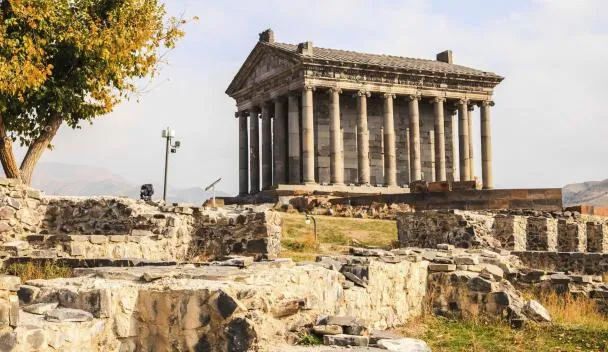
Perched on the edge of a dramatic basalt cliff, overlooking the deep Azat River canyon, the Temple of Garni stands as a breathtaking symbol of Armenia’s pre-Christian glory. It is the only surviving Greco-Roman colonnaded building in the entire former Soviet Union, a lone sentinel of classical antiquity in the heart of the Caucasus.
At Nour Armenia Tours, we believe every stone has a story. Located in the heart of the Kotayk Region, one of Armenia's premier travel destinations, the Garni Temple is more than just a site; it is a journey through time. From the Iron Age fortifications of the Urartians to the sacred solar rituals of Armenian kings, this guide explores the history, architecture, and natural wonders that make Garni a must-visit on your next Armenian adventure.
Commissioned by King Tiridates I in approximately 77 AD, the temple was dedicated to Mihr, the Armenian sun god associated with Mithra and Helios. Following a historic meeting with the Roman Emperor Nero, Tiridates returned to Armenia with the funds and vision to build this "impregnable fortress".
While most pagan temples were destroyed during Armenia's Christianization in 301 AD, Garni was spared. It was converted into a royal summer residence for Princess Khosrovidukht, who described it as a "cooling-off house". This unique transition preserved the structure until the devastating earthquake of 1679.
Unlike most Greek temples built from marble, Garni is constructed from local gray-black basalt—a volcanic stone notoriously difficult to carve. The precision of the 1st-century masonry, held together by iron cramps and lead instead of mortar, remains a testament to ancient engineering.
Just 50 meters from the temple lie the ruins of a 3rd-century Roman-style bathhouse. Here, you can walk through the remains of a sophisticated hypocaust underfloor heating system, a luxury imported directly from Rome’s eastern provinces.
The crown jewel of the bathhouse is the mythological mosaic floor. Created using natural stones from the Azat River in 15 different hues, it depicts Oceanus and Thalassa surrounded by marine life. It also features a cryptic Greek inscription: "μηδέν λαβόντες ηργασάμεθα" — "Without pay, we have been working". Was it a protest by unpaid artisans or a labor of love for a beloved king? The mystery remains unsolved to this day.
No trip to Garni is complete without descending into the gorge to witness the "Symphony of Stones" (or "Basalt Organ"). Formed 127,000 years ago by rapidly cooling lava, these massive hexagonal basalt columns soar up to 50 meters high, resembling the pipes of a giant musical instrument.
In July 2025, during the 47th session of the UNESCO World Heritage Committee, the Garni Archaeological Complex and Symphony of Stones was officially added to the UNESCO World Heritage Tentative List. This recognition highlights the site as an "outstanding universal value" for all humanity.
Today, Garni is not just a museum; it is the spiritual capital of Armenian Neopaganism (Hetanism). Practitioners often gather here to celebrate ancient holidays like Navasard (the New Year) in August and the birth of Vahagn in March. Visitors may witness traditional fire rituals, the lighting of apricot wood, and the tying of wish-ribbons to nearby trees.
Ready to stand where Armenian kings once stood? At Nour Armenia Tours, we offer expert-led private excursions to Garni, the Symphony of Stones, and the nearby UNESCO-listed Geghard Monastery. Let us handle the details while you soak in the history of the sun temple.
Contact us today to customize your journey into the heart of Armenian heritage.
WhatsApp us

Discover the Armenia world, one adventure at a time!






Charents 169 - Yerevan
Armenia
098883077 Nour Armenia Tours