Home » Geghard Monastery: Where Armenian History is Carved into the Living Mountain
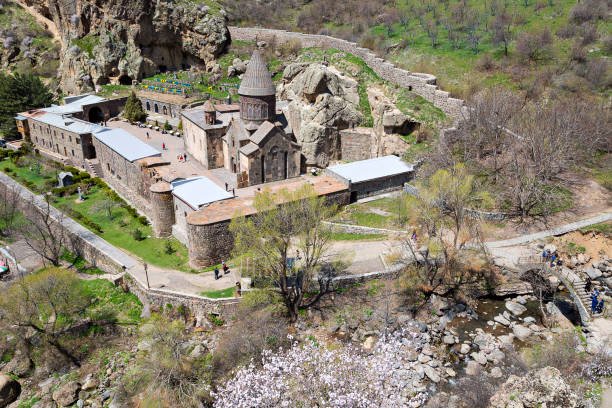
Welcome to Nour Armenia Tours. Today, we invite our Arab travelers to discover a site where the spiritual history of the Caucasus meets the sheer power of nature. Geghard Monastery is not simply a destination; it is a miracle carved into the "living rock" of the Azat Valley.
The Geghard Monastery, situated within the precipitous confines of the Azat River Gorge in the Kotayk Province of Armenia, represents one of the most sophisticated syntheses of medieval architectural ingenuity and natural landscape integration in the Christian world.
Originally established in the early 4th century by Saint Gregory the Illuminator, the complex serves as a primary testament to the conversion of Armenia to Christianity in 301 AD, an event that fundamentally reshaped the cultural and geopolitical trajectory of the Armenian Highland.
Historically referred to as Ayrivank, or the "Monastery of the Cave," the site evolved from a series of rudimentary rock-cut chapels built around a pre-Christian sacred spring into a massive monastic foundation that reached its zenith in the 13th century under the patronage of the Zakarian and Proshyan noble families. The modern designation, Geghardavank, meaning "Monastery of the Spear," reflects the site’s long-standing role as the repository for the Holy Lance, the relic believed to have pierced the side of Christ during the Crucifixion.
This analysis examines the historical, architectural, and socio-cultural dimensions of Geghard, articulating how its hybrid construction—partially built from masonry and partially excavated from the "living rock"—influenced the development of Armenian ecclesiastical design and preserved the nation's spiritual identity through centuries of regional instability.
The chronological development of the Geghard Monastery is characterized by distinct phases of establishment, destruction, and monumental reconstruction, reflecting the broader turbulence of Armenian history. The initial foundation in the 4th century coincided with Armenia's transition to a Christian state, the first nation in the world to do so by royal decree. Saint Gregory the Illuminator, having emerged from thirteen years of imprisonment in Khor Virap, initiated the construction of the first chapel at a site already venerated for its natural spring. This early iteration, known as Ayrivank, utilized the existing basalt caves of the gorge as ascetic dwellings and prayer spaces.
The subsequent centuries saw the monastery grow into a significant ecclesiastical center, though its physical structures were frequently compromised by regional conflicts and natural disasters. In 923 AD, the Arab vice-regent Nasr led a campaign of plunder that devastated Ayrivank, resulting in the loss of invaluable manuscripts and the destruction of the original architectural fabric.
The re-establishment of the monastery only began in earnest during the 12th and 13th centuries, a period often referred to as a "Golden Age" for Armenian architecture. This resurgence was facilitated by the Zakarid princes, Zakare and Ivane, who served as generals for the Georgian Queen Tamar and liberated Northern Armenia from Seljuk Turkish control.
Under the Zakarians, the monastery transitioned from a collection of caves to a structured complex, with the construction of the Katoghike (main church) in 1215. The mid-13th century brought another pivotal shift when Prince Prosh Khaghbakian purchased the monastery from the Zakarians. The Proshyan dynasty transformed Geghard into a royal sepulcher and an architectural marvel by commissioning the excavation of the most famous rock-cut churches and family tombs. This era defined the monastery’s current form, blending traditional masonry with sophisticated subterranean engineering.
| Period | Event / Structure | Significant Milestone | Architectural Style |
|---|---|---|---|
| 4th Century | Foundation of Ayrivank | Foundation by St. Gregory | Cave-based ascetic cells |
| 923 AD | Destruction and Plunder | Nasr (Arab vice-regent) | N/A (Destruction of initial site). |
| 1177 AD | St. Gregory Chapel (External) | Early Re-establishment | Rock-cut rudimentary chapel. |
| 1215 AD | Katoghike Church | Zakarian Princes | Cross-winged dome masonry. |
| 1215-1225 AD | Gavit (Narthex) | Zakarian Princes | Central-domed masonry hall. |
| 1230-1250 AD | Avazan Rock-Cut Church | Prince Prosh / Galdzag | Subtractive rock excavation. |
| 1283 AD | Proshyan Sepulcher & 2nd Rock Church | Proshyan Dynasty / Galdzag | Subterranean royal tomb/church. |
| 1288 AD | Upper Zhamatun | Papak Proshian / Ruzukan | High-acoustic funerary chamber. |
| 17th Century | Service & Residential Buildings | Late Monastic Community | Masonry utility structures. |
The Monastery of Geghard is inseparable from the geological and ecological context of the Azat River Valley. The site’s integration with the natural environment is so profound that the architecture and the surrounding landscape appear as a single, unified entity. The gorge itself is characterized by dramatic high cliffs of volcanic origin, primarily consisting of basalt and tuff. These geological features provided the "living rock" into which the medieval architects carved the monastery's most distinctive spaces.
The Azat River Gorge is famous for its columnar basalt formations, often described as the Symphony of Stones" due to their resemblance to organ pipes. This geological phenomenon is the result of slow-cooling lava, which fractured into regular hexagonal columns. These vertical structures provided a natural model for the columns and piers found within the monastery's architecture.
The availability of tuff—a light, porous, and easily workable volcanic stone—was essential for the intricate carvings that adorn the complex. Tuff's "breathable" properties also provided natural climate control within the monastery, keeping the interiors cool in summer and above freezing in winter.
The Upper Azat Valley is a biodiversity hotspot, largely due to its proximity to the Khosrov Forest State Reserve, one of the oldest protected areas globally. The reserve protects a diverse range of ecosystems, from semi-desert and phrygana to juniper and oak forests. The biological richness of this region supports numerous endemic and endangered species, making the valley a site of significant natural heritage alongside its cultural importance.
The interaction between the monastery and the valley is reflective of a medieval philosophy that viewed the natural world as a reflection of divine order. The monks who inhabited the rock-cut cells outside the main walls lived in direct contact with this biodiversity, emphasizing a life of seclusion and environmental harmony.
The masonry components of Geghard illustrate the peak of Armenian medieval architecture, combining classic forms with innovative decorative programs. The central monument of the "built" complex is the Katoghike Cathedral, which embodies the "cross-hall" type of church that exerted a profound influence across the Caucasus region.
Built in 1215, the Katoghike features a plan of an equal-armed cross inscribed within a square. The structure is topped by a high drum and a conical dome, a hallmark of Armenian ecclesiastical design. The external masonry is characterized by finely finished and fitted volcanic tuff, often in shades of grey or dark brown.
The southern portal of the Katoghike is its most elaborately decorated feature. The tympanum is adorned with bas-reliefs of pomegranates and grapevines, symbolizing the Eucharist and the spiritual fruitfulness of the Church. Above the portal, a prominent carving depicts a lion attacking an ox. This motif, while common in the Near East, is here interpreted as a symbol of the Zakarian family's power and their role as defenders of the faith. Internally, the church contains small two-story chapels in its corners, accessed by stairs protruding from the walls, which provided private spaces for the nobility and senior clergy.
The gavit, constructed between 1215 and 1225, serves as the primary entrance to the Katoghike and the transition point to the rock-cut sections. This large hall is supported by four massive free-standing columns that divide the space into nine vaulted sections. The central section is crowned by a "stalactite" or muqarnas vault, featuring a hole in the center to admit natural light.
The use of muqarnas in the Geghard gavit is a significant example of architectural hybridization. While the technique is of Islamic origin, Armenian architects adapted it to create complex stone stereotomies that emphasized the height and verticality of their structures. The gavit was a multifunctional space: it served as an assembly hall for the monastery’s school, a burial place for lesser nobles, and a receiving area for pilgrims who were drawn to the site by its famous relics.
The most innovative aspect of Geghard is the series of churches and tombs excavated entirely from the solid rock mass. This work, primarily overseen by the architect Galdzag in the mid-to-late 13th century, represents a supreme achievement in medieval engineering. These spaces were created through a "subtractive" process—carving into the mountain from the top down.
The Avazan, the first major rock-cut church (1230-1250), was excavated in the location of the monastery’s original sacred spring. Galdzag designed the church with eight semi-columns that support a central dome. A vertical skylight in the dome provides the only light source, which is strategically directed to create a dramatic chiaroscuro effect. The spring itself still flows into a small basin inside the church, and the floor includes engraved channels to manage the water, highlighting the engineering foresight required to integrate hydrological systems with sacred architecture.
Excavated in 1283, the Proshyan sepulcher (or zhamatun) and the adjacent St. Astvatsatsin church are characterized by their imitation of masonry forms in the living rock. Galdzag carved blind windows, coupled columns, and even a raised altar (apse) into the rock, mimicking the appearance of the "built" Katoghike.
The sepulcher is famous for the Proshyan family coat-of-arms, a high-relief carving on the northern wall. The composition features two lions chained to a ram's head, with an eagle clutching a lamb in its talons. This iconography serves as a visual testament to the dynasty's legitimacy and their protection of the monastery. The use of high-relief in these dark subterranean spaces was an engineering necessity, as shallower carvings would have been invisible in the low-light conditions.
The Upper Zhamatun, completed in 1288 for Papak Proshian and his wife Ruzukan, is perhaps the most acoustically advanced space in the complex. This chamber is divided into nine equal sections by four columns, replicating the form of the gavit. The rock-cut vaulting was engineered specifically to facilitate the resonance of Armenian liturgical chants. A small hole in the floor of the upper chamber connects it to the sepulcher below, allowing sound to travel between the levels, effectively turning the entire mountain wing into a resonating chamber for prayer.
The monastery's identity and its role as a pilgrimage site were fundamentally defined by the presence of the Holy Lance, or Geghard, from which the complex derives its name. According to the Armenian Apostolic Church, the spear was brought to Armenia by the Apostle Thaddeus in the 1st century AD.
The relic consists of a diamond-shaped iron head with a Greek cross cut through it. Its storage at Geghard for approximately 500 years turned the monastery into a spiritual fortress. The belief in the lance's supernatural power is captured in historical legends, such as the account of Tamerlane's invasion. It is said that the Turco-Mongol conqueror was forced to abandon his siege of the monastery after his soldiers were struck by divine paralysis upon seeing the lance. While the relic was moved to the Etchmiadzin Treasury in the 1760s for greater security, its legacy remains at Geghard, where a representation of the spear is carved into the monastery's entrance gate.
In addition to the lance, the monastery historically housed other significant relics, including remains of the Apostles Andrew and John. These objects attracted massive donations of land, money, and manuscripts from the Armenian nobility and commoners alike, ensuring the monastery's economic and cultural prosperity throughout the Middle Ages.
Geghard is home to some of the finest examples of khachkars (Armenian cross-stones) in existence. These memorial steles are deeply embedded in the Armenian identity, serving as personal expressions of faith and commemorations of significant events.
The khachkars at Geghard reflect the peak of the art form between the 12th and 14th centuries. Master carvers such as Timot and Mkhitar are credited with creating some of the most intricate examples, including the 1213 khachkar that displays "needle-carved" precision. The iconography of these stones often includes a central cross resting on a solar disc or rosette, symbols of eternity and the resurrection.
| Khachkar Master | Location / Site | Date | Notable Artistic Features |
|---|---|---|---|
| Timot & Mkhitar | Geghard Monastery | 1213 | Extremely delicate interlaced patterns; solar disc. |
| Vahram | Haghpat Monastery | 1273 | "Amenaprkich" (All-Savior) type; depicts the Crucifixion. |
| Poghos | Goshavank Monastery | 1291 | "Needle-carved" lace effect; master's name inscribed. |
The walls of Geghard and the surrounding cliff faces are covered in hundreds of smaller khachkars, many of which were left by pilgrims as a form of spiritual graffiti. These carvings represent a collective memory of the Armenian people, turning the very stone of the Azat Valley into a living archive of national history.
Geghard was a vital center for the development and preservation of Armenian liturgical music, specifically sharakans (hymns). The monastery's role as a music academy was supported by its unique rock-cut acoustics, which provided the ideal environment for choral training and performance.
Armenian chant is monodic and melismatic, organized into an eight-mode system called oktoechos. The earliest sharakans were composed in the 5th century by figures such as Mesrop Mashtots and Sahak Partev following the invention of the Armenian alphabet.
Between the 7th and 9th centuries, Armenian priests developed the khaz notation system—a series of neumes used to record the pitch and rhythm of the chants. However, by the 16th century, the complexity of the khaz system led to its becoming unreadable.
The musical tradition at Geghard was preserved primarily through oral transmission until the 19th-century efforts of Komitas Vardapet to reconstruct and modernize Armenian sacred music. Today, choirs continue to perform in the rock-cut chapels of Geghard, where the sound of the sharakans resonates with a clarity that bridges the gap between the material and the divine.
The Monastery of Geghard was a renowned intellectual center, housing a library and a scriptorium where monks copied and illustrated hundreds of manuscripts. Scholars such as Mkhitar Ayrivanetsi contributed significantly to Armenian historiography while residing at the monastery in the 13th century.
The education provided at Geghard was multidisciplinary, covering theology, calligraphy, philosophy, and music. The scriptorium's output was essential for the preservation of Armenian identity during periods of foreign rule, as manuscripts were often hidden or transported to other regions to save them from destruction during invasions. Many of the manuscripts produced at Geghard are now among the most prized possessions of the Matenadaran Museum of Ancient Manuscripts in Yerevan.
Geghard continues to function as an active monastery within the Armenian Apostolic Church, serving as both a local religious center and a major international tourist destination.
The tradition of matagh—a thanksgiving sacrifice—is a common sight at Geghard today. Pilgrims often bring a lamb or a rooster to the monastery to thank God for recovery from illness or safe return from military service. The ritual involves walking the animal around the church three or seven times and feeding it blessed salt before slaughter. The meat is then boiled (never grilled) and distributed to seven families among the poor or neighbors, maintaining a medieval practice of communal support and gratitude.
As a UNESCO World Heritage site, Geghard is protected under Armenian law, which prohibits unauthorized changes to its historic fabric. The site’s buffer zone includes the village of Goght and parts of the Azat Valley, ensuring that the visual relationship between the monastery and its natural setting remains intact. Modern conservation challenges include managing the impact of high tourism volume and addressing structural issues caused by the region's seismic activity.
The Monastery of Geghard is more than a collection of medieval buildings; it is a manifestation of Armenian spiritual resilience and technical ingenuity. Its hybrid nature—partly built of the earth's stones and partly carved from its living mass—reflects a profound understanding of the relationship between humanity, nature, and the divine. From the early 4th-century foundation of Ayrivank to the sophisticated 13th-century engineering of Galdzag, Geghard has served as a sanctuary for the Armenian soul.
The presence of the Holy Lance, the intricate beauty of the khachkars, and the otherworldly acoustics of the rock-cut chapels all contribute to a site that remains unique in the global heritage landscape. As both a historical monument and a living religious site, Geghard continues to draw pilgrims and scholars, offering a window into a medieval world where the physical and the spiritual were inextricably linked. Its preservation is not only a matter of national pride for Armenia but a significant contribution to the collective cultural memory of mankind.
Through the combined efforts of international organizations, the Armenian Apostolic Church, and modern researchers, the secrets of Geghard—from the engineering of its top-down excavations to the lost melodies of its sharakans—continue to be unraveled, ensuring that the architecture of eternity remains standing for future generations.
Would you like Nour Armenia Tours to organize a private guide for your visit to the Azat Valley?